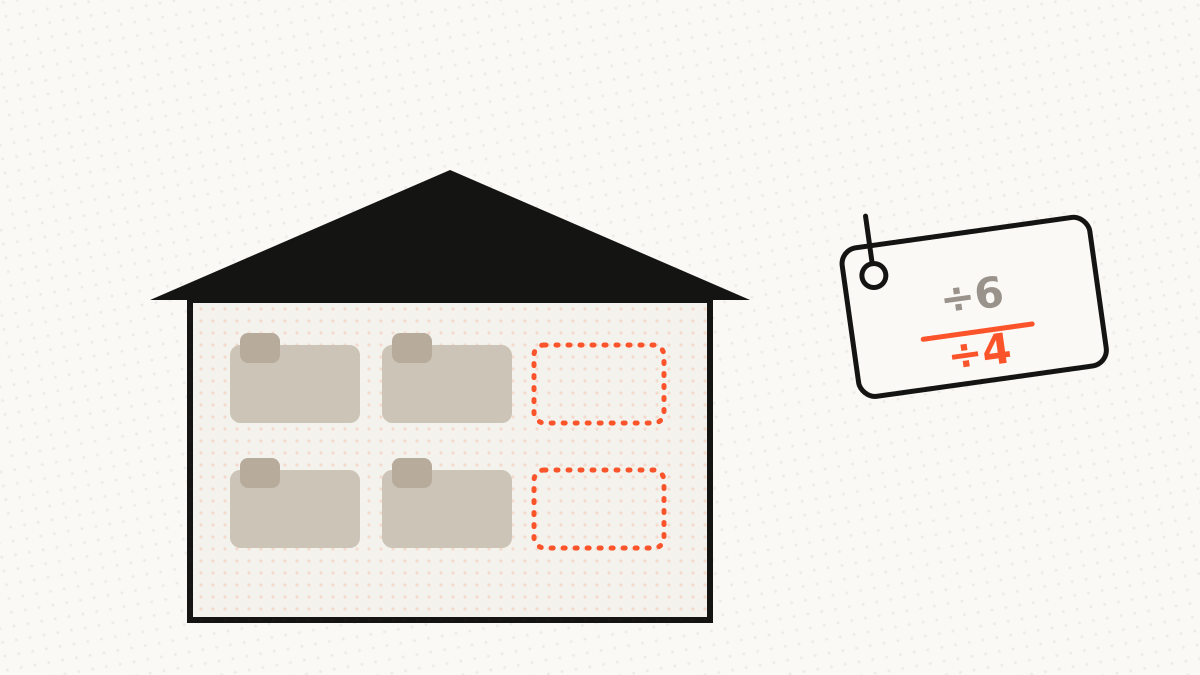
The house was booked for six. The deposit was paid, the flights were locked, and the per-person number was set on the assumption that six people would split it. Then, two weeks out, one person bailed.
Now there’s a hole. A non-refundable hole, usually, because the cancellation window closed weeks ago. And the group chat has gone from trip planning to a low-grade argument: does the person who dropped out still owe their share? Do the rest of you swallow it and re-split across five? Is anyone actually in the wrong here?
This one has a cleaner answer than most group-money fights, once you stop arguing about feelings and start asking two questions in order. First: is the money recoverable? Second: who actually committed to it? Run those two, in that order, and the answer falls out almost every time.
A quick honesty note before the tree. This is the logic groups use to settle these fairly. It isn’t legal advice, and it can’t override whatever you actually agreed to up front. If you had a clear deal in writing, that deal wins. If you didn’t, which is most groups, this is the fairest default.
Question one: is the cost recoverable?
Before anyone owes anyone anything, find out whether the money is actually gone.
If it’s recoverable, nobody eats anything. The room can be cancelled inside the free window, the flight has a refund or a credit, the booking can be transferred to someone else. Get the refund or fill the spot and the problem evaporates. Always check this first, because half the time the “non-refundable” cost has a refundable path nobody looked for. Email the host. Check the fare rules. See if a friend-of-a-friend wants the spot at face value.
If it’s genuinely gone, move to question two. The deposit is forfeited, the flight is a sunk cost, the booking can’t be transferred. Now it matters who committed to it, because someone is absorbing this and you want it to be the right someone.
Question two: who committed to the cost?
This is where most groups go wrong, and it’s worth slowing down on, because the fair answer is often not the obvious one.
If the person who bailed had committed to that specific cost, the loss is theirs. They said yes to the room. They were counted in the deposit. The booking was made on the strength of their commitment. Backing out doesn’t un-commit them from money that was already spent because of their yes. They owe their share of the forfeited cost. That’s the cleanest case in all of group travel, and it’s the one people feel guiltiest enforcing, even though it’s the most defensible.
The script for that conversation stays warm and factual:
Totally get that you can’t make it, no drama at all. The house deposit was non-refundable and we’d already booked on six, so your share of that comes to £90. Could you send that over when you can? Everything from here on we’ll just re-split across the five of us.
You’re separating the two buckets cleanly. The money already spent on their commitment, they cover. The future costs, the group re-splits. That’s fair to everyone and it’s easy to say.
If nobody had really committed yet, nobody eats it. If the bail happened before any money was spent on that person’s behalf, there’s nothing to settle. A “yeah I’m probably in” in the chat is not a financial commitment. The lesson there is about when commitment should have been locked, which we’ll get to.
If the group chose to absorb it, the group splits it. Sometimes you decide, as a group, to eat a dropout’s share rather than chase a friend who’s clearly struggling. That’s a generous, valid call. The key word is chose. It should be a decision the group makes out loud, not a default that quietly lands on whoever organized the trip.
And that brings us to the trap.
The answer most people get wrong
Here’s the one that catches the organizer every single time. If the cost is on your personal card, the loss is yours until you actively get it back.
When you said “I’ll just put the deposit on mine,” you didn’t just do the group a favor. You made yourself the one person legally and practically on the hook for the whole amount. The host refunds you or nobody. The chargeback risk is yours. And when a friend bails, the forfeited money came out of your account, which means you’re now in the awkward position of asking people to pay you back for a loss they can all see wasn’t your fault but is sitting on your card anyway.
“I’ll just put it on mine” is a more expensive favor than it looks. It feels like generosity in the moment. It quietly transfers all the risk to one person, and the cost of that transfer only shows up when something goes wrong, which on group trips it eventually does.
This is the same dynamic that turns one person into the group’s bank when nobody pays them back. If you’re already living that version of it, the playbook for getting your money back, in order, is right here: what to say when a friend won’t pay you back.
So if the bailed cost is on your card, don’t quietly absorb it. Run it through the two questions like any other cost, send the right person the right number, and re-split the rest. The fact that it touched your card first doesn’t make the loss morally yours. It just makes you the one who has to do the collecting, which is exactly the job you want to stop doing.
If you want to see the per-person figures cleanly before you start that conversation, the trip expense split calculator lets you re-split the forfeited cost and the remaining trip across the people who are actually still going.
How to never run this risk again
The reason a single dropout causes this much pain is that the commitment was soft and the money was hard. Everyone soft-agreed in a chat, then someone hard-spent real cash on the strength of those soft yeses. The fix is to make the commitment as real as the money before anyone fronts a card.
Agree what happens to a dropout’s share before you book, not after. One short conversation up front, while it’s still hypothetical and nobody’s feelings are involved: if someone bails after we’ve paid, their share of anything already spent is theirs, and we re-split everything future. Written in the chat, agreed by everyone, takes five minutes. It is far easier to agree this when it’s about a faceless hypothetical than about your friend who just got a new job and can’t come.
Make people commit with money, not words. A “yeah I’m in” costs nothing to walk back. A share paid in before the big bookings is a real commitment, and it means that if someone drops out, the money to cover their part of the non-refundable costs is already collected, not chased. You don’t need an app to do this. You need the group to agree that being “in” means having paid your part, not having reacted to a message.
Don’t let the whole trip ride on one person’s card. Spread the bookings so no single friend is carrying the group’s entire risk. If one cost falls through, it falls on a shared, visible balance rather than vanishing from one person’s bank account.
NomadCrew is built to make the second and third parts real. It’s a shared trip app where the whole crew sees one expense ledger, every cost is tagged to the person who paid it, balances update live, and people settle up inside the trip. So when someone’s share is in, everyone can see it’s in. When a cost is forfeited, it sits on a shared balance the whole group can see, not buried on one person’s card where it quietly becomes their problem. To be clear about what it does and doesn’t do: NomadCrew shows the numbers and runs the settle-up. It doesn’t hold or move your money, so the commitment and the collecting still happen between you. What it removes is the ambiguity, which is where these arguments actually live.
It’s in early access and free while we build. Start with the free trip expense splitter so the next trip begins with a shared number and an agreed answer, instead of a hole and an argument. If your crew uses Android, join the closed test. If you’re moving off Splitwise, here’s the Splitwise alternative for travel comparison.